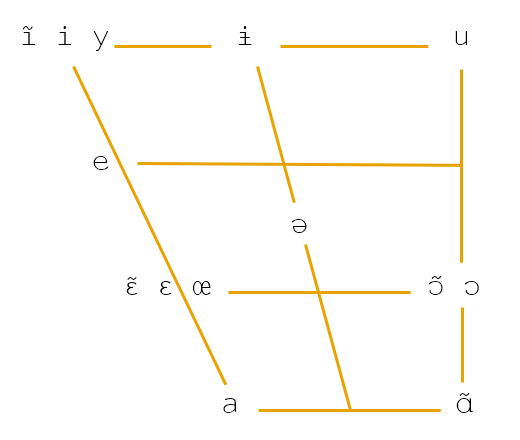
There are 10 vowels and 4 nasal vowels: Open front /a/ and open back nasalized /ɑ̃/, open-mid front /ɛ/ and its nasalized counterpart /ɛ̃/ and the open-mid front rounded /œ/, the open-mid back rounded /ɔ/ and its nasalized counterpart /ɔ̃/, the mid central /ə/, the close-mid front unrounded /e/, the close back rounded /u/, the close central unrounded /ɨ/, the close front unrounded /i/ and its nasalized counterpart /ĩ/ as well as the close front rounded /y/.
The vowel /e/ has an allophone [ɪ] which appears as the nucleus in syllables without an onset but with a coda: /empɛ̃/ becomes ['ɪm.pɛ̃] and /elgɔ̃dəl/ becomes [ɪɫ.'gɔ̃.dəɫ]. In all other positions (/evitat/ or /kʃezɛ/ for example) it remains [e].
/e/ becomes rhotacized [ɚ] when followed by /ɾ/ in closed syllables either immediately followed by a consonant as in /xenikerti/ [xe.'ni.kɚ.ti] or in word-final positions.
There are no diphthongs to speak of, although some loanwords might retain this feature.
However, vowels undergo a process of internal sandhi (see the article dedicated to sandhi) which can lead to some vowels disappearing, some turing into glides, and some shifting due to assimilation.
Nasal vowels, when combined with other vowels remain the same but provoke the appearance of [n] on the onset of the following syllable if it's a vowel: /mɑ̃/ + /ɛ/ = ['mɑ̃.nɛ] or /eŋgɛ̃/ + /i/ = [ɪŋ.gɛ̃.ni].
Here are the different combinations for non-nasal vowels :
For /a/
/a/ + /ɛ/ = /ɛ/
/a/ + /ɔ/ = /ɑw/
/a/ + /ə/ = /ə/
/a/ + /e/ = /e/
/a/ + /œ/ = /œ/
/a/ + /u/ = /aw/
/a/ + /ɨ/ = /ə/
/a/ + /i/ = /aj/
/a/ + /y/ = /əw/
For /ɛ/
/ɛ/ + /a/ = /a/
/ɛ/ + /ɔ/ = /ə/
/ɛ/ + /ə/ = /ə/
/ɛ/ + /e/ = /e/
/ɛ/ + /œ/ = /œ/
/ɛ/ + /u/ = /ɛw/
/ɛ/ + /ɨ/ = /ɨ/
/ɛ/ + /i/ = /ɛj/
/ɛ/ + /y/ = /ɛw/
For /ɔ/
/ɔ/ + /a/ = /wa/
/ɔ/ + /ɛ/ = /wɛ/
/ɔ/ + /ə/ = /wə/
/ɔ/ + /e/ = /we/
/ɔ/ + /œ/ = /wœ/
/ɔ/ + /u/ = /ɔw/
/ɔ/ + /ɨ/ = /wɨ/
/ɔ/ + /i/ = /wi/
/ɔ/ + /y/ = /ɑw/
For /ə/
/ə/ + /a/ = /ɥa/
/ə/ + /ɛ/ = /ɥɛ/
/ə/ + /ɔ/ = /ɥɔ/
/ə/ + /e/ = /ɥe/
/ə/ + /œ/ = /œ/
/ə/ + /u/ = /əw/
/ə/ + /ɨ/ = /ɨ/
/ə/ + /i/ = /əj/
/ə/ + /y/ = /y/
For /e/
/e/ + /a/ = /ja/
/e/ + /ɛ/ = /jɛ/
/e/ + /ə/ = /ə/
/e/ + /ɔ/ = /jɔ/
/e/ + /œ/ = /œ/
/e/ + /u/ = /ew/
/e/ + /ɨ/ = /ɨ/
/e/ + /i/ = /ɪj/
/e/ + /y/ = /y/
For /œ/
/œ/ + /a/ = /wa/
/œ/ + /ɛ/ = /wɛ/
/œ/ + /ə/ = /wə/
/œ/ + /ɔ/ = /wɔ/
/œ/ + /e/ = /we/
/œ/ + /u/ = /œw/
/œ/ + /ɨ/ = /ɥɨ/
/œ/ + /i/ = /œj/
/œ/ + /y/ = /wy/
For /u/
/u/ + /a/ = /wa/
/u/ + /ɛ/ = /wɛ/
/u/ + /ə/ = /wə/
/u/ + /ɔ/ = /wɔ/
/u/ + /e/ = /we/
/u/ + /œ/ = /uw/
/u/ + /ɨ/ = /wɨ/
/u/ + /i/ = /uj/
/u/ + /y/ = /wy/
For /ɨ/
/ɨ/ + /a/ = /ɛ/
/ɨ/ + /ɛ/ = /ɛ/
/ɨ/ + /ə/ = /ɨ/
/ɨ/ + /ɔ/ = /ɨw/
/ɨ/ + /e/ = /e/
/ɨ/ + /œ/ = /œ/
/ɨ/ + /u/ = /ɨw/
/ɨ/ + /i/ = /ɨj/
/ɨ/ + /y/ = /y/
For /i/
/i/ + /a/ = /ja/
/i/ + /ɛ/ = /jɛ/
/i/ + /ə/ = /jə/
/i/ + /ɔ/ = /jɔ/
/i/ + /e/ = /je/
/i/ + /œ/ = /jœ/
/i/ + /u/ = /ju/
/i/ + /ɨ/ = /jɨ/
/i/ + /y/ = /jy/
For /y/
/y/ + /a/ = /ɥa/
/y/ + /ɛ/ = /ɥɛ/
/y/ + /ə/ = /ɥə/
/y/ + /ɔ/ = /ɥɔ/
/y/ + /e/ = /ɥe/
/y/ + /œ/ = /ɥœ/
/y/ + /u/ = /ʊw/
/y/ + /ɨ/ = /ɥɨ/
/y/ + /i/ = /ɥi/
In the event of consonant clusters, two rules apply. The first and foremost is the voicing/devoicing of consonants: when the first syllable is accentuated, there is a regressive voicing/devoicing assimilation as in /bəsɣupɛ/ > ['bəs.xu.pɛ] ; when the second syllable is accentuated, there is a progressive voicing/devoicing as in /upgun/ > [ub.'gun].
The second rule is that of gemination: when two consonants in a cluster share a place of articulation, the consonant on the onset affects the coda, turning the pair into a geminate as in /d͡ʒardjattatɥə/ > ['d͡ʒad.djət.'ta.tɥə].
| * | * | Bilabial | Labiodental | Dental | Alveolar | Post-Alveolar | Palatal | Velar |
|---|---|---|---|---|---|---|---|---|
| Plosive | voiceless/aspirated | p / pʰ | t / tʰ | k / kʰ | ||||
| voiced | b | d | g | |||||
| Affricate | voiceless | t͡s | t͡ʃ | |||||
| voiced | d͡z | d͡ʒ | ||||||
| Fricative | voiceless | f | s | ʃ | x | |||
| voiced | v | z | ʒ | ɣ | ||||
| Nasal | voiced | m | n | ɲ | ŋ | |||
| Approximant | plain | l | j | |||||
| labial | ɥ | w | ||||||
| Tap | ||||||||
| voiced | ɾ |
Allophones:
The phoneme /l/ has two complementary allophones. It is pronounced [ɫ] when it appears in the syllable coda (V_) and as [l] in every other position.
/x/ has three complementary allophones. It is pronounced [ɣ] when preceded by a voiced consonant and right before a back vowel /u/, /ɔ/ or an open vowel /a/;
It is pronounced [h] after voiceless plosives (/k/, /t/ and /p/), voiceless affricates (/t͡s/, /t͡ʃ/) and /l/;
It stays [x] in all other positions.
/g/ is pronounced [ɣ] when in a complex onset (_CV) and followed by a sonorant (/n/, /m/, /l/, /ɾ/, /j/ and /ɥ/).
/ɾ/ is pronounced [l] when followed by a consonant that shares a manner of articulation (plosives and affricates) due to a process of dissimilation.
Word stress is fixed according to the number of syllables and depends on the morphology of words. In single-root words like tīhü /tixy/ ['ti.xy] the stress falls on the first syllable; this is also the case for primary stress in words which begin with a prefix like mököltök /mœ/ + /kœltœk/ ['mœ.kœl.tœk] or ankese /̃ɑ/ + /kɛsɛ/ ['̃ɑ.kɛ.sɛ].
In double-root words, or "tandem" words, the primary stress falls on the seccond root, as in tagjeg /təg/ + /jɛg/ [təɣ.'jɛg].
Many words have an accumulation of prefixes; when this happens, the stress falls on the final prefix as in andżārimpent /̃ɑ/ + /d͡ʒaɾ/ + /empɛ̃t/ [̃ɑ.d͡ʒa.'ɾem.pɛ̃t] or gerorejute /gɛɾ/ + /ɔɾɛ/ + /jutɛ / [gɛ.'ɾɔ.ɾɛ.ju.tɛ].
For any word with 4 or more syllables, the stress will be on the antepenultimate syllable as in gertāddwānod [gɛɾ.tad.'dwa.nɔd].
Syllables can be organised in a variety of ways. In fact, the base of vērvānje's structure is made of simple CV, VC, and CVC roots. Progressively, more complex syllables came to be as affixes, inflection and derivation became necessary. Certain ideal words just didn't have reasonable pronounciations, so I applied some basic linguistic rules and experimented. So far, the acceptable maximum amount of vowels and consonants for a single syllable is CCVCC, epitomised by the adjective swuft /swuft/ [swuft] meaning 'poor'.